
An outdoor kitchen floor works harder than almost any other floor in a home. It carries a grill, a fridge, a sink and a dining table, it gets wet when it rains, it gets greasy near the cooking zone, and in Ontario it freezes, thaws, freezes again, and then has to look good for the first barbecue of spring. Choosing tile for outdoor kitchen floor use is therefore not about picking a pretty sample in a showroom. It is about picking a surface that stays safe underfoot, stays flat through winter, and still cleans up after a long cookout.
The short answer is simple. For most Niagara outdoor kitchens, exterior grade porcelain tile is the best starting point, and 20 mm porcelain pavers are the best choice where a raised or dry laid floor makes sense. Both are porcelain, so both resist stains, heat and frost far better than ordinary indoor tile. The choice between them comes down to how the floor will be built, how much grip you need, and how the base drains. This guide explains each decision in plain terms, compares the realistic options, and gives you a checklist you can take to a tile supplier or installer.
The short answer: start with porcelain
Porcelain is made from dense, finely ground clay fired at high temperature. Good exterior porcelain absorbs 0.5 percent water or less, which is why it is rated impervious. That low absorption matters in Ontario because tile that soaks up water can crack when that water freezes and expands. A dense porcelain tile, set correctly on a sound base, is built for that cycle in a way that softer ceramic tile is not.
Porcelain also handles the daily life of an outdoor kitchen. It does not burn, it does not melt near a grill, and hot grease will stain grout long before it damages a glazed porcelain surface. It resists most food acids, sauces and cleaning products, and it does not need sealing the way many natural stones do. For a floor that will see tomato sauce, marinade, beer, sunscreen and muddy shoes, that low maintenance profile is a real advantage.
That does not mean every porcelain tile will work outdoors. A polished indoor porcelain tile can be dangerously slippery when wet, and a thin indoor tile may not be rated for frost at all. Look for the words exterior grade, frost proof or frost resistant on the product sheet, check the water absorption figure, and check the slip rating before you fall in love with a colour. If a supplier cannot confirm those three points in writing, keep shopping.
Frost resistance for Ontario winters
Ontario winters punish outdoor floors in three ways. Water gets into pores and joints and then freezes. Deicing salt sits on the surface for months. And the ground and the slab below move slightly as they freeze and thaw. A floor that survives all three needs the right tile, the right setting materials, and joints that can move a little without cracking.
Start with absorption. Porcelain at 0.5 percent or less is the standard to insist on for an uncovered or partly covered outdoor kitchen. Frost proof certification is the next check, because it tests the tile itself through freeze and thaw cycles rather than relying on a general claim. Our guide to best outdoor tile for a Canadian winter explains those ratings in more detail, including salt resistance and why covered areas still freeze.
Setting materials matter just as much. Outdoor work needs exterior rated mortar and grout, and movement joints where the tile field meets walls, posts and changes of plane. A rigid tile field with no place to move will eventually crack, usually at the weakest point, which is often a corner or a long straight joint. This is an overview, not an installation manual, but any quote for your floor should name the exterior mortar, the grout type and the movement joint plan. If it does not, ask.
Slip resistance around cooking and water
An outdoor kitchen combines the two slip risks that matter most: water and grease. Rain blows in, ice melt drips off shoes, a sink splashes, a drink spills, and cooking oil finds its way to the floor. A tile that feels fine dry in a showroom can feel very different when it is wet and a little greasy.
Use the ratings, not your hand. For outdoor kitchen floors, look for an R11 slip rating, or a dynamic coefficient of friction of 0.42 or higher, as the practical target for open and wet areas. R10 is a minimum for covered areas that stay mostly dry, but R11 gives more margin where water and food spills are routine. A textured or matte finish usually grips better than a polished finish, and a structured surface that you can feel under your fingers is a good sign.
Candidate materials compared
Not every hard surface sold for patios belongs under an outdoor kitchen. The table below compares the realistic tile options on the points that matter in Ontario: frost behaviour, grip, heat and grease handling, and upkeep. Use it to narrow the list, then check the exact product sheet for the tile you plan to buy, because finishes vary within every material family.
| Material | Best for | Watch out for |
|---|---|---|
| Exterior porcelain tile, 9 to 10 mm, bonded | Most outdoor kitchens on a sound concrete slab, best balance of frost resistance, grip and cleaning | Needs a correct base, exterior mortar and movement joints, and a textured finish for wet grip |
| 20 mm porcelain pavers | Raised floors on pedestals, dry laid floors over compacted base, and heavy use areas | Higher material cost and heavier handling, and the build method must suit the base |
| Quarry tile | Rustic kitchens where a traditional, unglazed look is wanted | More porous than porcelain, so frost rating and sealing must be checked carefully |
| Natural stone such as granite or slate | High end kitchens where natural variation is the priority | Needs sealing, can stain from grease, and some stones are weaker in freeze and thaw |
| Ordinary indoor ceramic tile | Indoor use only, not recommended outdoors | Higher absorption, lower frost resistance and often a slippery glaze when wet |
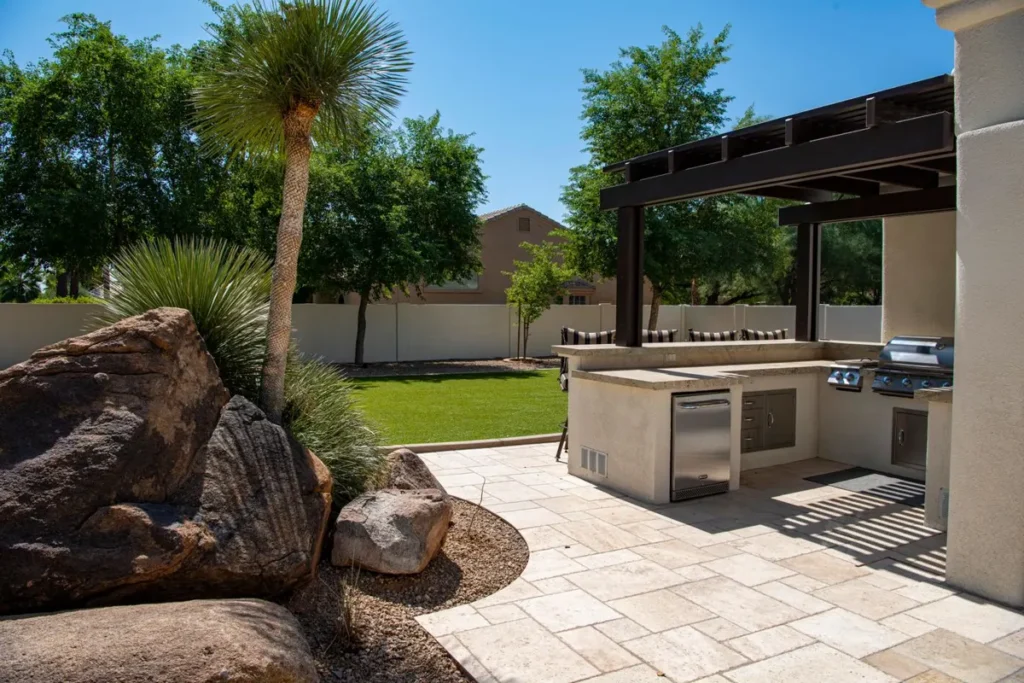
Porcelain pavers deserve a closer look because they are often confused with ordinary pavers. A 20 mm porcelain paver is still porcelain tile, only thicker and stronger, and it can be bonded to a slab, laid dry over a prepared base, or raised on pedestals to create a level floor over a sloping or uneven area. Our comparison of outdoor porcelain pavers vs concrete explains how that thickness affects long term value and winter behaviour. The key point for an outdoor kitchen is that thickness alone does not make a floor frost proof. The tile rating, the base and the drainage still decide the result.
Thickness and strength: 9 to 10 mm tile or 20 mm pavers
Standard exterior porcelain tile is usually 9 to 10 mm thick and is bonded to a concrete slab with mortar. That is plenty strong for foot traffic, a grill, a fridge and a dining set, provided the slab is sound and the mortar coverage is complete. Voids under a tile are a weak point outdoors, because water can collect there and freeze, so full coverage matters more than extra thickness on a bonded floor.
Twenty millimetre pavers add strength for raised and dry laid systems and for places where the floor must bridge small gaps or carry heavier point loads. They also give installers more options when the existing slab is not level or when services need to run under the floor. They are not automatically better on a flat, sound slab, where a well bonded 9 to 10 mm tile performs very well and costs less. Choose the system that fits your base, not just the thickest product on the shelf.
Heat and grease near grills
Tile is one of the few outdoor kitchen floor finishes that is genuinely comfortable near heat. Porcelain does not burn, and a dropped hot pan or a hot grill grate will not melt or scorch it the way it would damage wood decking or some composites. That is a major reason porcelain is a natural fit beside a built in grill.
Grease is the more practical problem. Cooking fat splatters, drips from a grill and tracks on shoes. On glazed porcelain, grease sits on the surface and can be wiped or washed away. In grout, grease can darken the joint over time, especially with light coloured grout. Two choices reduce that headache: a mid tone grout that hides normal cooking marks, and a grout sealer applied after curing and renewed as the maker directs. Dark grout is not a cure for poor cleaning, but it makes a busy cooking zone look better between deep cleans.
Size and heat underfoot
Size changes both the look and the feel of an outdoor kitchen. Large format tiles, such as 24 inch by 24 inch or 12 inch by 24 inch, make a small kitchen feel larger and reduce the number of grout lines to clean. Smaller formats add grip and suit curved edges and drains, but they add grout lines and cleaning time. A middle size is often the best compromise for a kitchen that must be both safe and easy to maintain.
Drainage and slope at overview level
Water must leave an outdoor kitchen floor. It should not pond around a grill, sit against a house wall, or collect in a low corner where it freezes into a sheet of ice. As a rule of thumb, an outdoor tiled surface is laid to fall about 2 percent away from the house, which is about one quarter inch per foot. Your installer will set the exact fall for your slab, drains and door thresholds, and that fall must be checked before tile is laid, because tile cannot fix a slab that drains the wrong way.
The base under the tile
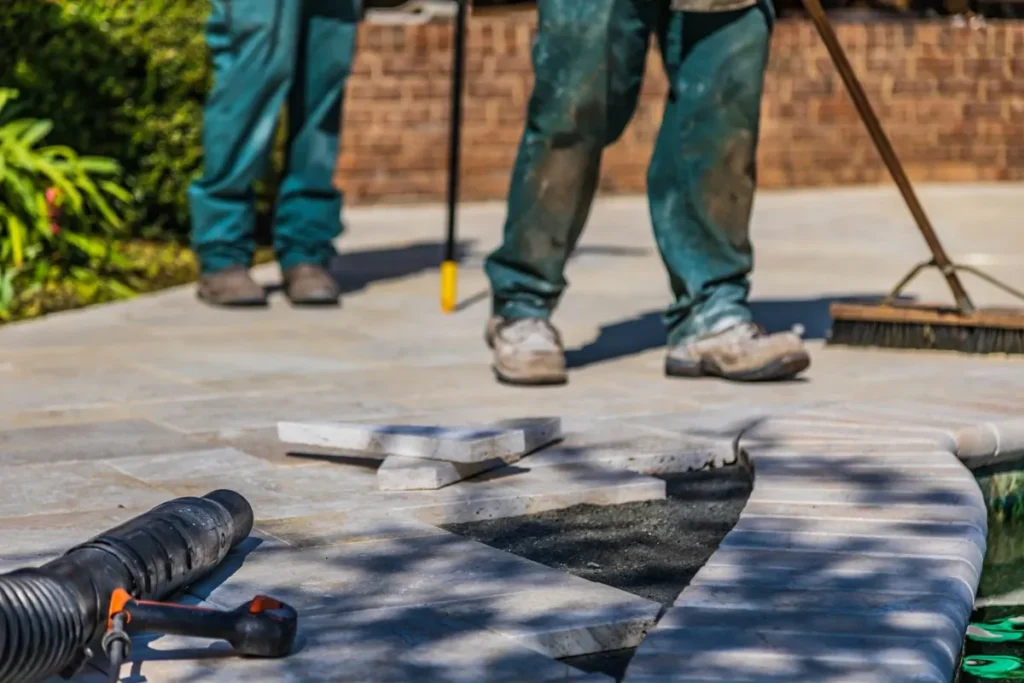
Most outdoor kitchen floors in Niagara are bonded tile on a concrete slab, and the slab decides much of the result. It should be sound, free of wide cracks and coatings that block mortar bond, and it should already drain away from the house. A slab that moves, heaves or drains toward the house will pass those problems to the tile, however good the tile is.
Maintenance through the seasons
Porcelain outdoor kitchen floors are low maintenance, not no maintenance. Sweep regularly so grit does not grind into grout, wash with water and a neutral cleaner, and rinse after cooking sessions that leave grease. Avoid harsh acids on grout unless a product maker directs it, and test any new cleaner in a corner first. In winter, porcelain itself is indifferent to deicing salt, but salt residue still looks untidy and can make the floor slippery when it dries to a film, so rinse it off when the weather allows.
Check the floor each spring. Look for cracked grout, loose tiles, joints that have lost sealant, and any area where water now ponds. Small grout and sealant repairs in spring are cheap. A loose tile left through another winter can become a cracked tile and a trip edge. Keep a few spare tiles from the original batch if you can, because dye lots change and a future repair will match far better with spares on hand.
Quick spec checklist before you buy
- Exterior grade porcelain, frost proof rated, water absorption 0.5 percent or less.
- Slip rating R11, or a dynamic coefficient of friction of 0.42 or higher, in a textured matte finish.
- Thickness matched to the build: 9 to 10 mm bonded on a sound slab, or 20 mm pavers for raised or dry laid floors.
- Exterior mortar and grout, movement joints at walls and changes of plane, and a fall of about 2 percent away from the house.
- Mid tone grout, sealed after curing, and a few spare tiles kept from the original batch.
If you can confirm those five points, you have removed most of the risk from an outdoor kitchen floor. Colour and pattern then become a design choice, not a gamble. For a second view on whether porcelain suits an uncovered winter floor, see can porcelain tile be used outside in winter.
Watch: installing outdoor porcelain tiles
The video below, How to install outdoor porcelain tiles by From The Ground Up, shows outdoor porcelain tile work in practice and is a useful visual companion to the base and layout points above.
BGM Construction installs tile floors for outdoor kitchens across the whole Niagara Region, including Thorold, Niagara Falls, St. Catharines, Welland, Fort Erie, Grimsby, Lincoln, Niagara-on-the-Lake, Pelham, Port Colborne, Wainfleet and West Lincoln. If you are planning an outdoor kitchen in Thorold, Niagara Falls, St. Catharines or Welland, or anywhere else in the region, talk to us before you buy tile so the slab, drainage, thickness and grip rating are right for your kitchen and your winter.
Frequently Asked Questions
What is the best non-slip outdoor tile?
Textured exterior porcelain with an R11 rating, or a dynamic coefficient of friction of 0.42 or higher, is the best practical choice for wet outdoor kitchen floors, because it keeps grip when water and grease are present.
Which porcelain tiles are not slippery?
Matte, structured porcelain tiles with a high slip rating are far less slippery than polished porcelain. Check the rating on the product sheet and test a wet sample rather than judging by a dry showroom floor.
What type of tile is best for an outdoor kitchen?
Exterior grade porcelain is best for most outdoor kitchens, bonded at 9 to 10 mm on a sound slab, or as 20 mm pavers for raised or dry laid floors. It resists frost, heat, stains and grease better than indoor ceramic tile.
What are some frost-proof outdoor tiles?
Frost-proof exterior porcelain tiles and 20 mm porcelain pavers with water absorption of 0.5 percent or less are the main frost-proof tile options for Ontario. Always confirm the frost rating for the exact product, not just the material family.
Can grease stain an outdoor kitchen tile floor?
Grease rarely damages glazed porcelain, but it can darken grout over time. Wipe spills promptly, choose a mid tone grout, and seal grout after curing to keep a cooking zone looking clean.
Do I need 20 mm pavers for an outdoor kitchen?
Not always. Twenty millimetre pavers suit raised and dry laid floors and heavier point loads, but a well bonded 9 to 10 mm exterior porcelain tile on a sound slab is strong enough for most outdoor kitchens.