
Ask what size diamond blade for porcelain tile you need, and the short answer surprises most buyers: the size is decided by your saw, not by your tile. A 7 inch blade belongs on a 7 inch tabletop saw, a 10 inch blade on a 10 inch professional saw, and a 4.5 inch blade on an angle grinder, full stop. The tile enters the decision one step later, in the rim type and the bond printed beside the size on the label. Buyers who start with the tile end up standing in the aisle trying to fit the biggest blade the shelf offers onto a saw that was never built for it, and a blade that overhangs its guard, outruns its arbor or spins past its rating is not a bargain, it is a hazard. This guide reads the label the way an installer does: diameter, arbor, speed, rim, then price. The tool choice itself, wet saw vs snap tile cutter, is a separate question we answer in its own guide, and the hub for the setting side is our thinset and materials hub.
Diameter: Match the Saw, Then Check the Depth
| Saw | Blade diameter | Typical arbor | Rough depth of cut |
|---|---|---|---|
| Angle grinder | 4.5 in (115 mm), some 5 in (125 mm) | 7/8 in (22.23 mm) | About 1 in usable |
| Tabletop tile saw | 7 in (180 mm) | 5/8 in | About 1.75 in |
| Mid size tile saw | 8 in (200 mm) | 5/8 in | About 2.25 in |
| Professional tile saw | 10 in (250 mm) | 5/8 in or 1 in | About 3 in |
| Bridge saw and masonry saw | 12 to 14 in | 1 in | 4 in and up |
Depth of cut is the diameter’s quiet second job. A 7 inch blade reaches about 1.75 inches of cut depth, which swallows any tile and most pavers, and a 10 inch blade reaches about 3 inches. That is why tile thickness almost never forces a bigger blade: even a 20 mm porcelain paver rides within a 7 inch blade’s depth. What diameter really buys you on the bigger saws is throat room and table size for large pieces, not cutting power. Our guide to cutting large format tile covers the saws that carry the 10 inch and bridge sizes. Going the other way is forbidden in both directions: a smaller blade on a big saw wastes the machine and can lose the tile under the table slot, and a bigger blade on a small saw will not fit the guard and arbor at all.
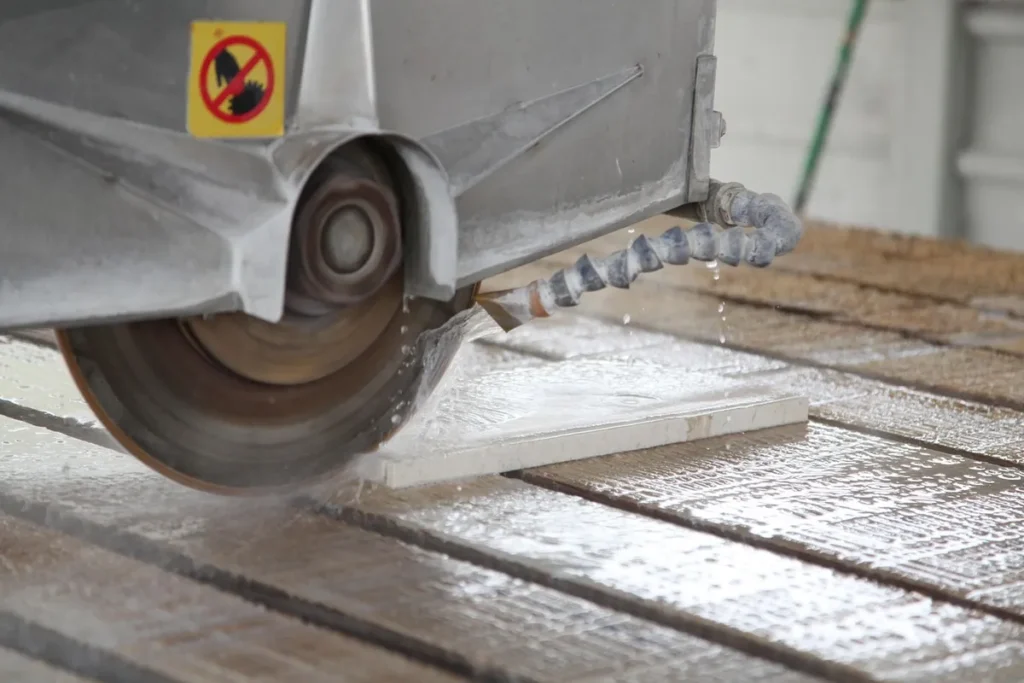
The Arbor: The Number That Has to Match Exactly
The arbor is the hole in the middle, and it has one job: to sit on the saw’s shaft with no play at all. The common pairings are 5/8 inch on 7, 8 and 10 inch tile saws, 7/8 inch (22.23 mm) on grinders and their 4.5 and 5 inch blades, and 1 inch on larger professional and bridge saws. Some blades ship with a reducer ring to step a 1 inch bore down to 5/8, and a properly seated ring is fine. What is never fine is a blade wobbling on an undersized shaft or shimmed with tape and optimism. An off centre blade cuts a wider, rougher kerf, chips the glaze all along the cut, vibrates the tile on the table and wears its rim in patches. Half the mystery bad cuts blamed on cheap blades are arbor fit problems. Check the pairing on the box against the plate on the saw before the purchase, not at the bench.
The Speed Rating: One Rule With No Exceptions
Every blade carries a maximum RPM, and every saw carries a spindle speed. The blade’s number must meet or beat the saw’s number. A typical 7 inch tile saw spins around 3,600 RPM and its blades are rated far above that (a RIDGID 7 inch premium porcelain blade, for example, is rated to 8,730 RPM), so tile saws are usually safe territory. Grinders are where the rule bites: an angle grinder spins at 10,000 to 11,000 RPM, and a blade rated only for a slow saw must never be mounted on one. A blade run past its rating can shed segments or fail outright. Read the RPM line on every blade, every time, including the free one in the box with a new saw.
Rim Type: Where Porcelain Actually Gets Its Vote
Now the tile decides. Diamond blades cut with one of three rim styles. A continuous rim is a smooth unbroken edge of diamond grit, and it produces the cleanest cut in porcelain, which is why it is the default answer for glazed and polished tile. A turbo rim carries small angled slots that clear debris and cut faster, and the modern thin turbo mesh variant, around 1.2 to 1.4 mm thick, has become the porcelain specialist: fast, cool and nearly as clean as a continuous rim. A segmented rim has deep gullets between teeth and cuts like a chainsaw by comparison; it belongs on brick, block and soft masonry, and it will chip porcelain edges all day. Kerf thickness rides along with rim choice. Thinner blades remove less material, load the motor less and wander less, which is exactly what hard porcelain wants. Segment height, the depth of the diamond band at 7 to 10 mm on quality tile blades, is your wear budget: taller segments mean a longer lived blade at a higher price. The cutting technique that keeps those edges clean in the hand is in our guide on cutting porcelain without chipping.
Bond Hardness: The Spec Nobody Reads and Everybody Feels
The rim is diamond grit held in a metal bond, and the bond’s hardness has to disagree with the material in the right direction. Hard porcelain needs a soft bond: the bond wears away at a steady rate, dull diamonds are shed, and fresh sharp diamond keeps reaching the cut. Put a hard bond blade on porcelain and the diamonds polish flat against the hard surface while the bond refuses to release them, so the blade glazes, slows, sparks and starts pushing the tile instead of cutting it. Soft abrasive materials want the opposite, a hard bond that holds its diamonds against the scouring. Manufacturers print this as material ratings on the blade: porcelain, ceramic, stone, glass. Believe the print over the price tag. Glass is its own purchase entirely, a fine grit continuous rim made for it, and stone blades rated for granite will work on porcelain in a pinch while porcelain blades die young on abrasive stone, a distinction that matters on jobs like our marble tile installation work where both materials share a bench.
One more line on the label decides where the blade may work. Wet rated blades are built to run flooded, and the water is not optional: it cools the rim, clears the cut and keeps silica dust out of the air. Dry rated blades, the kind sold for grinders, tolerate the heat of dry cutting and still cut cleaner with water whenever the setup allows it. A blade with no dry rating, run dry on a grinder, will overheat, warp and glaze inside a single long cut. Match the rating to the tool and the setup you actually have.
Prices, Glazing and the Dressing Stone
In Canadian stores, expect about $25 to $45 for a serviceable 4.5 inch grinder blade, $35 to $80 for a good 7 inch porcelain blade, and $60 to $140 for a 10 inch blade worth keeping. The cheapest blade on the shelf is rarely the cheapest per cut: thin steel cores flex and wobble, sparse diamond loads glaze early, and a blade that ruins two $8 tiles has already lost to the $70 blade that ruins none. When a good blade slows down, starts sparking or leaves a burnt smell, it has usually glazed rather than worn out, and the fix is a dressing stone: a soft abrasive block run through the blade a few times to strip the polished bond and expose fresh diamond. Thirty seconds of dressing resurrects blades that get thrown away every week on other crews’ sites.
Watch: Reading a Blade Label Before You Buy
This walk-through of tile saw blade selection works through diameter, rim and material rating on real blades, which is the aisle skill this whole guide is about. (Third-party tutorial video.)
Tile Work Across the Niagara Region
BGM Construction keeps a blade library the way a kitchen keeps knives: continuous rim for glazed porcelain, thin turbo mesh for hard through body work, glass blades for glass, stone blades for stone, all sized to the saws on the truck. The crews tile in Thorold, Niagara Falls, St. Catharines and Welland, and across Fort Erie, Grimsby, Lincoln, Niagara-on-the-Lake, Pelham, Port Colborne, Wainfleet and West Lincoln.
For tile work quoted with the right tools already in the price, call BGM Construction at +1 365-524-1898, or visit 5 Swart Ln, Thorold, ON L2V 0G5. Open Monday to Saturday: 8:00 AM to 5:00 PM.
Frequently Asked Questions
What size diamond blade do I need for porcelain tile?
The size your saw was built for: 4.5 inch for an angle grinder, 7 inch for a tabletop tile saw, 10 inch for a professional saw. Within that size, choose a continuous rim or thin turbo mesh blade rated for porcelain, with an arbor that matches your shaft exactly and an RPM rating above your saw’s speed.
Can I fit a 10 inch blade on a 7 inch tile saw?
No. The blade will not clear the guard or the table, the arbor and tray are built for the smaller diameter, and running an oversized blade defeats the guard the saw’s safety design depends on. If the work needs a 10 inch saw, rent the 10 inch saw.
Does a bigger blade cut porcelain cleaner?
No. Cleanliness comes from the rim type and the bond, not the diameter. A 7 inch continuous rim blade cuts porcelain cleaner than a 10 inch segmented blade every time. Diameter buys depth of cut and table room; rim and bond buy finish.
Continuous rim or turbo blade for porcelain?
Continuous rim for the cleanest edge on glazed and polished porcelain, which is most exposed edge work. A thin turbo mesh blade, around 1.2 to 1.4 mm, is the faster choice for hard through body porcelain and loses very little on finish. Segmented rims are the wrong tool for porcelain edges entirely.
Why does my new blade spark, wobble or cut slowly?
Sparking and slow cutting usually mean a glazed blade or a bond too hard for porcelain; dress the blade on an abrasive stone and check the material rating. Wobble usually means arbor mismatch or a blade not seated flat on clean flanges. A blade that does all three from new is often simply the wrong blade for the material.
Can one blade cut porcelain, marble and glass?
Porcelain and marble can share a quality continuous rim blade rated for both, though the blade will live a shorter life on abrasive stone. Glass should not share: it needs its own fine grit continuous rim blade, and a general blade will chip glass edges no matter how carefully it is fed.









2 Responses