
Here is the verdict first, because it is simpler than the marketing makes it sound. A snap cutter wins on straight cuts in ceramic and standard porcelain, and it is not close: no setup, no water, no walk to the garage, a cut in seconds beside your knees. A wet saw wins on everything else, meaning thick porcelain, natural stone, glass, and any cut that is not a straight line from one edge to another. Most one bathroom projects need one of the two and rent or borrow the other for an afternoon. Most professionals own both and reach for whichever the cut in front of them demands. The rest of this guide puts real numbers and real tile types against that verdict on the wet saw vs snap tile cutter question, so the tool you buy is the one your project actually runs on. The broader material planning behind the job, from thinset quantities to setting order, sits in our R1A hub.
How Each Tool Actually Cuts
A snap cutter does not cut at all, in the sawing sense. A small carbide or titanium scoring wheel runs along a rail and scratches a line into the glazed surface of the tile. Then a breaker foot presses on either side of the score and the tile snaps along the line, the way glass is cut. The whole event takes seconds, produces no dust cloud and no noise worth mentioning, and needs nothing but floor space and a steady hand. Because the tile breaks rather than being ground away, the break follows the score only when the tile body cooperates, which is where material limits come from.
A wet saw works like a tiny table saw whose blade does the grinding. A diamond rimmed blade spins through a tray of water, the water keeps the blade cool and the dust down, and the tile slides through the cut on a table or under a bridge. The blade removes material along the whole line, so the cut goes where you steer it: straight, diagonal, stopped halfway for a notch, or angled for a mitre. That control is bought with everything the snap cutter skips: power, water management, a blade spinning at thousands of RPM, overspray on the operator, and a tray of grey slurry to clean up afterwards.
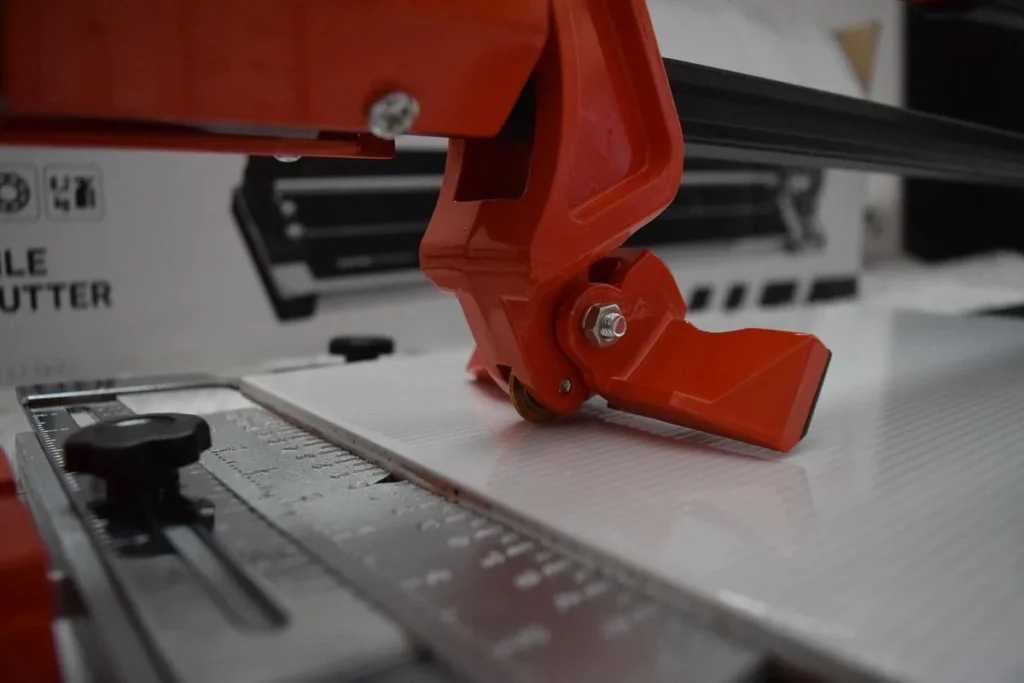
Wet Saw vs Snap Cutter: The Head to Head
| Factor | Snap cutter | Wet saw |
|---|---|---|
| Best at | Fast straight cuts in ceramic and porcelain | Any material, any cut shape |
| Cut shapes | Straight lines only, edge to edge | Straight, diagonal, L cuts, notches, mitres, curves with practice |
| Materials | Ceramic, standard porcelain, some glass with the right wheel | All tile, stone, brick pavers, thick porcelain |
| Edge quality | Good, sometimes slightly rough on hard glazes | Cleanest with a continuous rim blade |
| Setup time | None | 10 to 20 minutes, plus water and cleanup |
| Mess | A snapped offcut and score dust | Slurry, overspray, wet work area |
| Noise | A click and a snap | Loud enough for ear protection |
| Buy price in Canada | About $60 to $400 for DIY to pro rail models | About $150 to $450 tabletop, $700 and up professional |
| Rental | Rarely rented | About $45 to $75 per day at Ontario tool rentals |
| Consumables | Scoring wheels, roughly $15 to $30 | Blades, roughly $30 to $120, plus pumps and filters |
What Each Tool Cannot Do
The snap cutter’s limits are geometric and material. Geometric first: it cannot stop a cut in the middle of a tile, so L shaped cuts around a door jamb or a socket notch are off the table, and it cannot shave a 5 mm sliver off an edge without the tile shattering to the score. Curves are out entirely. Material limits are about body density. Through body porcelain, the very hard unglazed kind used on commercial floors, can refuse to break cleanly and chip or wander off the score. Natural stone snaps where its veins feel like it, not where you scored it. Thick tile past about 12 to 15 mm defeats most breaker feet. Every one of those jobs belongs to the saw.
The wet saw’s limits are logistical. It is slow at production straight cutting, and the reason is not the cut itself. The Ceramic Tile Education Foundation timed it honestly: figure a minute or more per cut once you count marking, walking to the saw, cutting, wiping the tile dry and walking back, against about five seconds to score and snap at the stack beside your knees. Over a 300 square foot floor with two cuts per tile, that arithmetic becomes hours. A saw also cuts nothing until it is set up, filled and plugged in, and it leaves the room it worked in wet. For a backsplash of forty straight cuts, the saw spends more time being cleaned than cutting.
Edge Quality: Where Each Edge Is Allowed to Live
A snapped edge and a sawn edge are both presentable, but they are not interchangeable. A good snap on a quality porcelain produces an edge that is straight and square with a slightly softened top corner, perfectly fine anywhere the edge is covered by trim, sits in a corner, or runs into a grout line. A hard glaze can micro chip along the score on bargain tile, which reads as a faint lighter line along the cut. A wet saw with a continuous rim diamond blade produces the tidiest edge of any method, the one you want on an exposed edge at eye level, on polished porcelain, and around a shower niche. The deciding question is not which edge is better in the abstract; it is where the edge will live. Our companion guide on cutting porcelain without chipping covers the technique side of clean edges on both tools.
Cost of Ownership, Honestly Counted
For a single bathroom, the arithmetic usually looks like this. A decent DIY snap cutter at $80 to $150 handles every straight cut in ceramic and standard porcelain, pays for itself against one day of saw rental, and lives in a closet afterwards for the next room. A tabletop wet saw at $200 to $400 is the buy when the project includes stone, thick porcelain, glass, or a stack of notches and L cuts, or when a second and third project are already planned. Renting the saw at Ontario rates buys the professional machine for a weekend at a fraction of its price, and the rental counter hands you a sharp blade with it. The blade question matters more than buyers expect, since a worn blade makes a good saw cut like a bad one; our guide on diamond blade size for porcelain tile decodes the numbers before you spend.
Size capacity settles some purchases before price does. Snap cutters are sold by the longest tile they can score and break: match the rail to your tile’s longest diagonal if you plan 45 degree layouts, and check the thickness rating against your tile body. Saws are limited by throat depth and blade diameter, which set the longest straight pass and the deepest cut. Tile bigger than either tool’s honest capacity is its own discipline, covered in our guide to cutting large format tile, and the setting side of those pieces is in our large format tile installation tips.
The Verdict by Project
- Kitchen backsplash in ceramic or subway porcelain: snap cutter, start to finish, with a rod saw or nippers for the two socket notches.
- Bathroom floor in 12×24 porcelain: snap cutter for the field, wet saw or grinder on standby for the vent and flange cutouts.
- Shower in stone, marble or thick porcelain: wet saw, no debate, with the snap cutter welcome to help on any straight wall cuts.
- Glass tile feature wall: wet saw with a glass rated blade; most glass refuses to snap cleanly.
- Porcelain plank flooring across a whole main floor: buy the best snap cutter you can justify, and rent the saw for the complicated room.
- One room, tight budget, standard tile: snap cutter, plus a $30 tile nipper for the fiddly bits.
Ask a working installer what to buy first and the answer is usually the snap cutter, sized generously, because eighty percent of cuts on eighty percent of jobs are straight. The saw follows when the work does. That order also matches how skills build: the snapper teaches you layout and marking with cheap mistakes, while the saw punishes a wandering hand at full speed.
Watch: Wet Saw vs Snap Cutter, Timed Honestly
The Ceramic Tile Education Foundation put both tools on the clock in this comparison, and the time gap on production straight cuts is the whole argument in miniature. Watch where each tool earns its keep. (Third-party tutorial video.)
Tile Cutting Is One Line in a Bigger Job
BGM Construction runs both tools on every project across the Niagara Region, because real rooms mix easy field cuts with awkward corners. Crews are based in Thorold and tile in Thorold, Niagara Falls, St. Catharines and Welland, and across Fort Erie, Grimsby, Lincoln, Niagara-on-the-Lake, Pelham, Port Colborne, Wainfleet and West Lincoln. A homeowner planning a DIY run is welcome to call for the honest version of which tool their tile needs before money is spent at the rental counter.
For a quote on the whole job instead, call BGM Construction at +1 365-524-1898, or drop by 5 Swart Ln, Thorold, ON L2V 0G5. Open Monday to Saturday: 8:00 AM to 5:00 PM.
Frequently Asked Questions
Is a wet saw or a snap cutter better for porcelain tile?
For straight cuts in standard porcelain, the snap cutter is faster and cleaner to live with. For thick porcelain, through body porcelain and any cut that is not straight, the wet saw is better and sometimes the only option. The tile and the cut shape decide, not the tool’s price tag.
Can a snap cutter cut porcelain at all?
Yes, and it is the standard production tool for it. A quality rail cutter with a sharp scoring wheel snaps glazed porcelain cleanly all day. The exceptions are very hard through body porcelain, tile thicker than about 12 to 15 mm, and bargain cutters whose breaker feet flex before the tile does.
What cuts can a snap cutter not make?
Anything that does not run straight from one edge of the tile to another: L shaped cuts, socket notches, curves, mitres and narrow slivers under about 10 mm. Those go to the wet saw, a grinder with a diamond blade, or hand nippers for small bites.
Is it worth buying a wet saw for one bathroom?
Usually not, unless the bathroom uses stone, glass or thick porcelain throughout. Renting a professional saw for a weekend in Ontario runs about $45 to $75 a day and the blade comes sharp, while a tabletop saw worth owning starts around $200. Buy the snap cutter, rent the saw, and keep the difference for tile.
Which tool leaves the cleaner edge?
The wet saw with a continuous rim blade, on exposed edges and polished tile. A good snap leaves a perfectly serviceable edge for grout lines, corners and trim covered edges. Judge by where the edge will live, not by which tool costs more.
Do professionals use snap cutters or wet saws?
Both, on the same job, often on the same wall. The snap cutter lives beside the installer for production straight cuts and the saw sits outside or in the garage for stone, notches and anything curved. Owning only one is a homeowner constraint, not a professional standard.